Fractional Ownership Explained Simply
Why it’s important to choose a secure crypto wallet?
Lorem ipsum dolor sit amet, consectetur adipiscing elit lobortis arcu enim urna adipiscing praesent velit viverra sit semper lorem eu cursus vel hendrerit elementum morbi curabitur etiam nibh justo, lorem aliquet donec sed sit mi dignissim at ante massa mattis.
- Neque sodales ut etiam sit amet nisl purus non tellus orci ac auctor
- Adipiscing elit ut aliquam purus sit amet viverra suspendisse potent i
- Mauris commodo quis imperdiet massa tincidunt nunc pulvinar
- Adipiscing elit ut aliquam purus sit amet viverra suspendisse potenti
How do I know how secure is my wallet?
Vitae congue eu consequat ac felis placerat vestibulum lectus mauris ultrices cursus sit amet dictum sit amet justo donec enim diam porttitor lacus luctus accumsan tortor posuere praesent tristique magna sit amet purus gravida quis blandit turpis.

Are there any other risks I should take account for?
At risus viverra adipiscing at in tellus integer feugiat nisl pretium fusce id velit ut tortor sagittis orci a scelerisque purus semper eget at lectus urna duis convallis. porta nibh venenatis cras sed felis eget neque laoreet suspendisse interdum consectetur libero id faucibus nisl donec pretium vulputate sapien nec sagittis aliquam nunc lobortis mattis aliquam faucibus purus in.
- Neque sodales ut etiam sit amet nisl purus non tellus orci ac auctor
- Adipiscing elit ut aliquam purus sit amet viverra suspendisse potenti
- Mauris commodo quis imperdiet massa tincidunt nunc pulvinar
- Adipiscing elit ut aliquam purus sit amet viverra suspendisse potenti
“Nisi quis eleifend quam adipiscing vitae aliquet bibendum enim facilisis gravida neque velit euismod in pellentesque massa placerat”
Wrapping up: Crypto is a great wallet for you
Eget lorem dolor sed viverra ipsum nunc aliquet bibendum felis donec et odio pellentesque diam volutpat commodo sed egestas aliquam sem fringilla ut morbi tincidunt augue interdum velit euismod eu tincidunt tortor aliquam nulla facilisi aenean sed adipiscing diam donec adipiscing ut lectus arcu bibendum at varius vel pharetra nibh venenatis cras sed felis eget.
Fractional Ownership Explained Simply
This article explains the concept of fractional ownership and how it has been used across different asset types and ownership structures. Instead of a single person holding full ownership of an asset, fractional ownership allows multiple participants to hold defined portions of the same asset. These ownership interests are typically structured through legal agreements that define rights, responsibilities, and how benefits associated with the asset are shared.
Fractional ownership has been used in a variety of contexts, including company shares, partnerships, and property arrangements. In recent years, some analysts have discussed how digital technologies such as blockchain systems and tokenization may influence how fractional ownership records are created and managed. These systems are being explored as part of broader discussions about digital ownership infrastructure and asset management.
What Is Fractional Ownership?
Fractional ownership refers to an arrangement in which multiple individuals or entities hold defined portions of a single asset rather than one party holding full ownership. Each participant holds a fraction, or share, that represents a specific ownership interest defined through contractual or legal structures.
A simple analogy is dividing something into equal portions. Instead of a single person controlling the entire asset, ownership is divided among several participants, with each holding a clearly defined portion. The specific rights associated with each share, such as usage rights, income distributions, or governance participation, depend on the legal structure governing the asset.
Forms of fractional ownership have existed for many years. Corporate shares represent fractional ownership in a company, while partnerships and joint ventures allow multiple participants to share ownership of assets such as real estate or businesses. These arrangements allow assets to be owned collectively while still defining individual ownership interests.
In real estate contexts, fractional ownership structures may allow multiple participants to hold defined ownership interests in a property. The legal framework governing the property determines how income, responsibilities, and decision-making are handled among participants.
Why Is Fractional Ownership Discussed in Asset Structures?
Fractional ownership structures are often discussed in relation to how ownership interests can be divided among multiple participants. Instead of requiring a single owner to hold an entire asset, fractional structures allow ownership units to be divided into smaller portions.
Some observers note that dividing ownership into smaller units may influence how participants interact with certain asset markets. In some cases, smaller ownership units may allow participants to hold portions of assets that might otherwise require a single large ownership position.
Fractional ownership structures can also influence how ownership transfers occur. When an asset is divided into multiple shares, transferring a portion of ownership may involve transferring only a fraction rather than the entire asset. The ability to transfer ownership interests depends on the legal structure governing the asset and any regulatory requirements that apply.
In some modern systems, digital infrastructure is used to record fractional ownership interests. Distributed ledger systems and other digital databases may be used to document ownership units and record transfers between participants, depending on how the platform is designed.
Overall, fractional ownership is commonly discussed as a structural method for organizing shared ownership arrangements across different types of assets.
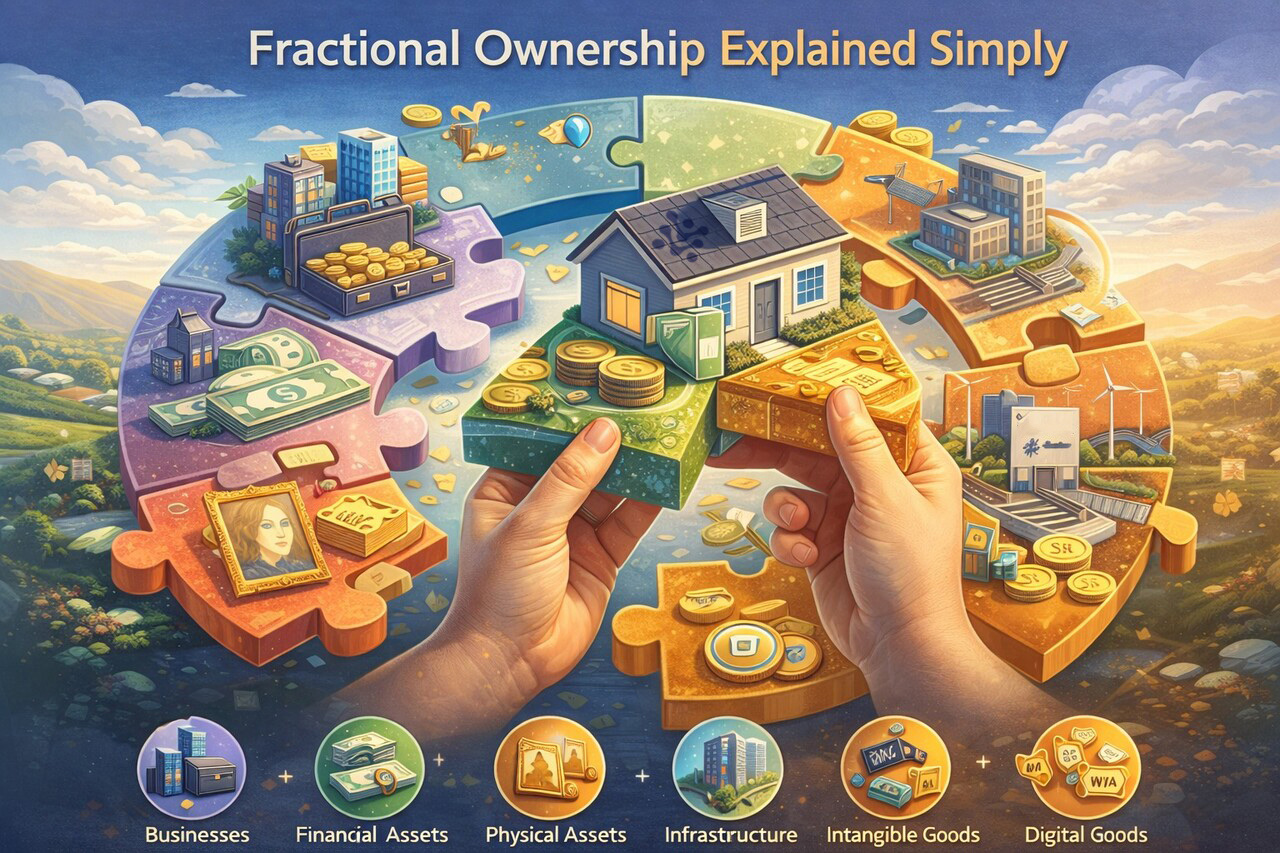
What Kind Of Assets Can Be Owned Fractionally?
Fractional ownership structures can apply to many types of assets when ownership rights can be clearly defined through legal or contractual frameworks.
Real Estate
Real estate is one of the most widely discussed examples of fractional ownership. Properties such as residential buildings, commercial properties, or land can be structured so that multiple participants hold defined ownership interests in the same property. The specific rights associated with these interests are determined by the legal agreements governing the asset.
Businesses
Corporate shares represent a widely recognized form of fractional ownership. When individuals hold shares in a company, they hold ownership interests that correspond to a portion of the company’s equity according to the number of shares they hold.
Financial Assets
Some financial instruments represent fractional participation in larger pools of assets. For example, investment funds or structured financial vehicles may allow participants to hold proportional interests in diversified asset pools depending on the structure of the fund.
Physical Assets
Certain high-value physical assets may also be structured with fractional ownership arrangements. In some cases, assets such as art, collectibles, or commodities may be held through ownership structures that divide the asset into defined ownership interests.
Infrastructure and Development
Large infrastructure projects, such as energy facilities, transportation infrastructure, or large-scale development projects, may involve ownership structures where multiple parties contribute capital and hold defined ownership interests within the project entity.
Intangible Goods
Intellectual property and digital rights can also be structured with fractional ownership. In some cases, rights related to music catalogs, patents, licensing agreements, or digital media assets may be divided among multiple parties through contractual arrangements.
Real World Assets (RWAs)
Some emerging systems explore representing ownership interests in assets through digital tokens recorded on distributed ledger systems. In these models, tokens may correspond to defined ownership units or contractual rights associated with an asset. However, the legal validity and transferability of such ownership interests depend on the legal and regulatory frameworks governing the asset and the platform managing the records.
Overall, fractional ownership is commonly used across many asset classes as a way to organize shared ownership arrangements where multiple participants hold defined interests in the same underlying asset.